




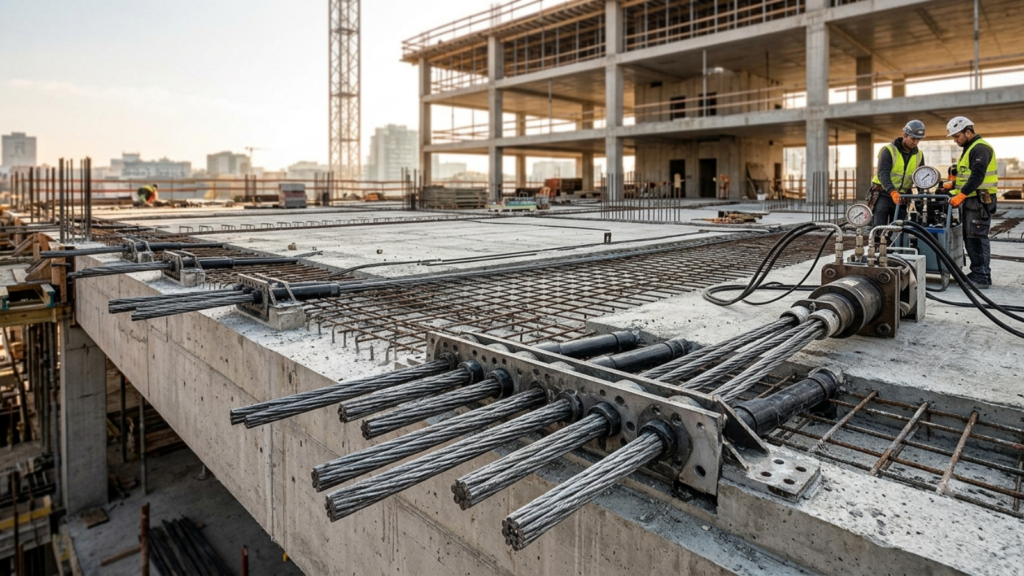
Monostrand vs multistrand post-tensioning may sound complicated, but the basic difference is actually simple: monostrand uses one steel strand in a tendon, while multistrand uses several strands together.
At Strut and Tie, we believe structural engineering should be easy to understand. So, let’s break down how these systems work, where engineers use them, and what makes each one different.
What Is Post-Tensioning?
Concrete is strong in compression but weaker in tension. Post-tensioning helps overcome this limitation by using high-strength steel tendons to introduce compression into the concrete.
The basic process is:
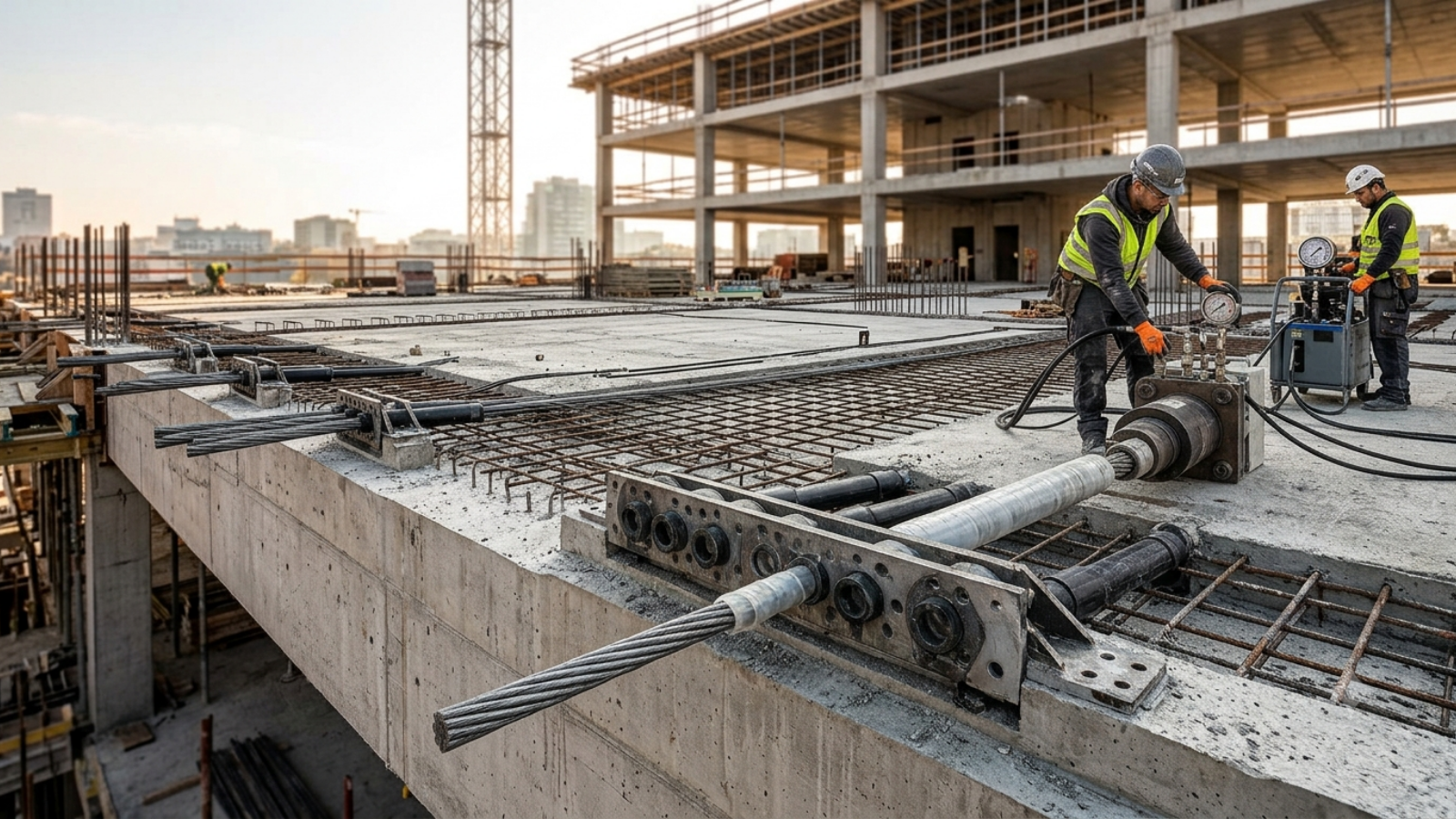
Place the tendon → Cast the concrete → Stress the steel → Anchor it → Transfer the force to the concrete.
As a result, post-tensioning can help structures handle loads efficiently, achieve longer spans, and reduce the need for deeper structural members in suitable designs.
Monostrand Post-Tensioning: One Strand at a Time
As the name suggests, “monostrand” means “one strand.”
Each tendon contains a single high-strength steel strand, usually placed inside a protective sheath. After the concrete reaches the required strength, workers use a hydraulic jack to stretch the strand and then lock it at the anchorage.
Think of it as one strong rope being pulled tight and secured at both ends.
Where Is Monostrand Used?
Monostrand systems are commonly used for:
- Residential buildings
- Commercial floor slabs
- Flat slabs
- Parking structures
- Building floors
- Smaller structural members
Key Benefits:
- Simple installation: Individual strands are easier to handle and position.
- Faster construction: The straightforward system works well for repetitive slab construction.
- Flexible placement: Engineers can arrange individual tendons according to the structural requirements.
- Practical for building projects: It works particularly well where the structure needs multiple individual tendons rather than very high forces in one tendon.
Limitations:
However, monostrand systems may become less practical when a project requires very high prestressing forces. Large bridges, transfer girders, and heavy structural members often need several strands working together.
That is where multistrand systems come into play.
Multistrand Post-Tensioning: Several Strands Working Together
A multistrand tendon contains multiple steel strands inside one duct.
Instead of stressing one strand at a time, several strands work together to provide a higher prestressing force.
A simple way to picture it:
Monostrand: One strong rope
Multistrand: Several ropes working together
Where Is Multistrand Used?
Engineers commonly use multistrand systems in:
- Bridges
- Large beams
- Transfer girders
- Long-span structures
- Heavy commercial buildings
- Industrial structures
- Infrastructure projects
Key Benefits
- Higher capacity: Multiple strands can deliver a much greater prestressing force.
- Good for long spans: The system works well when structures need to cover larger distances.
- Suitable for heavy loads: Large structural members can benefit from the higher tendon capacity.
- Efficient for major structures: Several strands can work together as one powerful tendon.
Limitations
Multistrand systems also require more attention during construction.
They generally need:
- Larger stressing equipment
- More complex anchorage arrangements
- Careful duct installation
- Skilled installation
- Proper stressing and grouting procedures where applicable
Therefore, engineers select multistrand systems when the structural requirements justify this additional complexity.
Monostrand vs Multistrand: What’s the Difference?
Feature | Monostrand | Multistrand |
Strands per tendon | One | Multiple |
Typical application | Building slabs | Bridges & large structures |
Tendon capacity | Lower per tendon | Higher per tendon |
Equipment | Smaller | Larger |
Installation | Generally simpler | More complex |
Best suited for | Slabs & repetitive projects | Heavy loads & long spans |
The important thing is that neither system is automatically better. The right choice depends on the project’s span, loading, structural design, construction method, and performance requirements.
Bonded vs Unbonded: Don’t Confuse Them
There is another important distinction in post-tensioning.
Monostrand vs. multistrand post tensioning describes the number of strands.
Bonded vs unbonded describes whether the tendon bonds to the surrounding concrete.
Bonded System
After stressing, workers pump grout into the duct. Once the grout hardens, it bonds the tendon to the surrounding concrete and helps protect the steel.
Unbonded System
The steel remains inside a protective sheath and does not bond to the concrete along its length.
How Do You Choose the Right System?
Engineers consider several factors before selecting a post-tensioning system, including:
- Span length
- Structural loads
- Required prestressing force
- Structural geometry
- Deflection
- Construction method
- Durability
- Cost
- Maintenance
For example, monostrand can be a practical choice for building slabs, while multistrand can suit bridges and large transfer structures that require greater prestressing forces.
Ultimately, the structure determines the right system.
Conclusion
Monostrand vs multistrand post-tensioning provide different ways to strengthen and improve concrete structures. Monostrand offers a practical solution for many building slabs, while multistrand provides higher tendon capacity for bridges, large beams, and demanding structural applications.
At Strut and Tie, we turn complex structural requirements into practical engineering solutions. Planning a project involving post-tensioning? Connect with Strut and Tie to explore the right system for your structure and build with confidence from the design stage.